

|
|
|
Functions | |
| template<typename KNearestNeighbours , typename Point_random_access_range > | |
| void | Gudhi::witness_complex::landmark_choice_by_furthest_point (Point_random_access_range const &points, int nbL, KNearestNeighbours &knn) |
| Landmark choice strategy by iteratively adding the furthest witness from the current landmark set as the new landmark. More... | |
| template<typename KNearestNeighbours , typename Point_random_access_range > | |
| void | Gudhi::witness_complex::landmark_choice_by_random_point (Point_random_access_range const &points, int nbL, KNearestNeighbours &knn) |
| Landmark choice strategy by taking random vertices for landmarks. More... | |
| template<class KNearestNeighbors , class SimplicialComplexForWitness > | |
| void | Gudhi::witness_complex::witness_complex (KNearestNeighbors const &knn, int nbL, int dim, SimplicialComplexForWitness &sc) |
| Iterative construction of the witness complex. More... | |
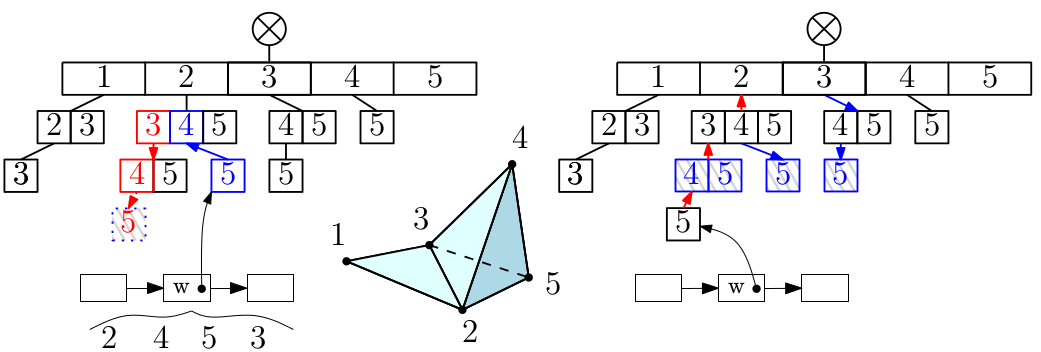
Witness complex  is a simplicial complex defined on two sets of points in
 :
 set of witnesses and
 set of landmarks.
The simplices are based on landmarks and a simplex belongs to the witness complex if and only if it is witnessed, that is:
 is witnessed if there exists a point
 such that w is closer to the vertices of
 than other points in
 and all of its faces are witnessed as well.
The data structure is described in [4] .
The principal class of this module is Gudhi::Witness_complex.
In both cases, the constructor for this class takes a {witness}x{closest_landmarks} table, where each row represents a witness and consists of landmarks sorted by distance to this witness. This table can be constructed by two additional classes Landmark_choice_by_furthest_point and Landmark_choice_by_random_point also included in the module.
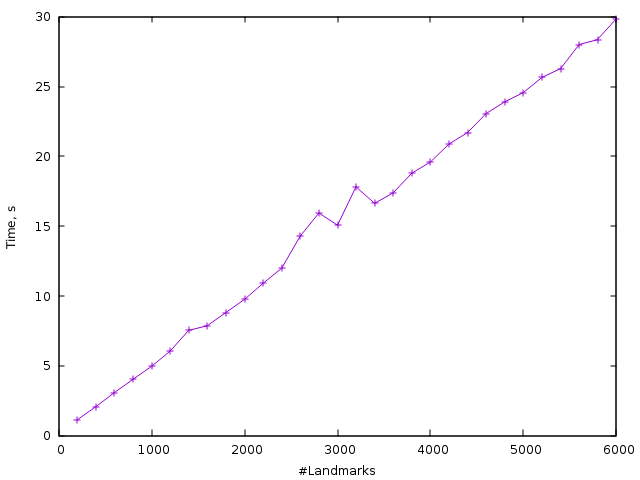
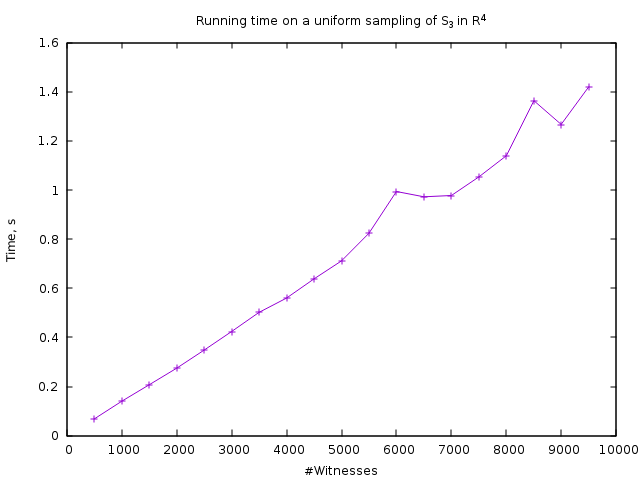
| void Gudhi::witness_complex::landmark_choice_by_furthest_point | ( | Point_random_access_range const & | points, |
| int | nbL, | ||
| KNearestNeighbours & | knn | ||
| ) |
Landmark choice strategy by iteratively adding the furthest witness from the current landmark set as the new landmark.
It chooses nbL landmarks from a random access range points and writes {witness}*{closest landmarks} matrix in knn.
The type KNearestNeighbors can be seen as Witness_range<Closest_landmark_range<Vertex_handle>>, where Witness_range and Closest_landmark_range are random access ranges
| void Gudhi::witness_complex::landmark_choice_by_random_point | ( | Point_random_access_range const & | points, |
| int | nbL, | ||
| KNearestNeighbours & | knn | ||
| ) |
Landmark choice strategy by taking random vertices for landmarks.
It chooses nbL distinct landmarks from a random access range points and outputs a matrix {witness}*{closest landmarks} in knn.
The type KNearestNeighbors can be seen as Witness_range<Closest_landmark_range<Vertex_handle>>, where Witness_range and Closest_landmark_range are random access ranges and Vertex_handle is the label type of a vertex in a simplicial complex. Closest_landmark_range needs to have push_back operation.
| void Gudhi::witness_complex::witness_complex | ( | KNearestNeighbors const & | knn, |
| int | nbL, | ||
| int | dim, | ||
| SimplicialComplexForWitness & | sc | ||
| ) |
Iterative construction of the witness complex.
The witness complex is written in simplicial complex sc_ basing on a matrix knn of nearest neighbours of the form {witnesses}x{landmarks}.
The type KNearestNeighbors can be seen as Witness_range<Closest_landmark_range<Vertex_handle>>, where Witness_range and Closest_landmark_range are random access ranges.
Procedure takes into account at most (dim+1) first landmarks from each landmark range to construct simplices.
Landmarks are supposed to be in [0,nbL_-1]
| GUDHI Version 1.3.0 - C++ library for Topological Data Analysis (TDA) and Higher Dimensional Geometry Understanding. |
Generated on Fri Apr 15 2016 17:36:21 for GUDHI by
 1.8.6 |